
Reflections from AIxED 2026: Educators’ Process of Learning AI
By Kippy Smith
Last Saturday in Boston, sideby’s SVP of Learning, Kippy Smith, moderated a panel at the AIxEd Conference to explore how real educators are learning AI in real time with three members of the sideby learning community: Yousuf Marvi, an 8th-grade math and ELD teacher in Irvine Unified; Akesha Horton, Director of Academic Engagement at Indiana University; and Anne Fensie, Director of the Center for Teaching and Learning at the University of Maine at Presque Isle.

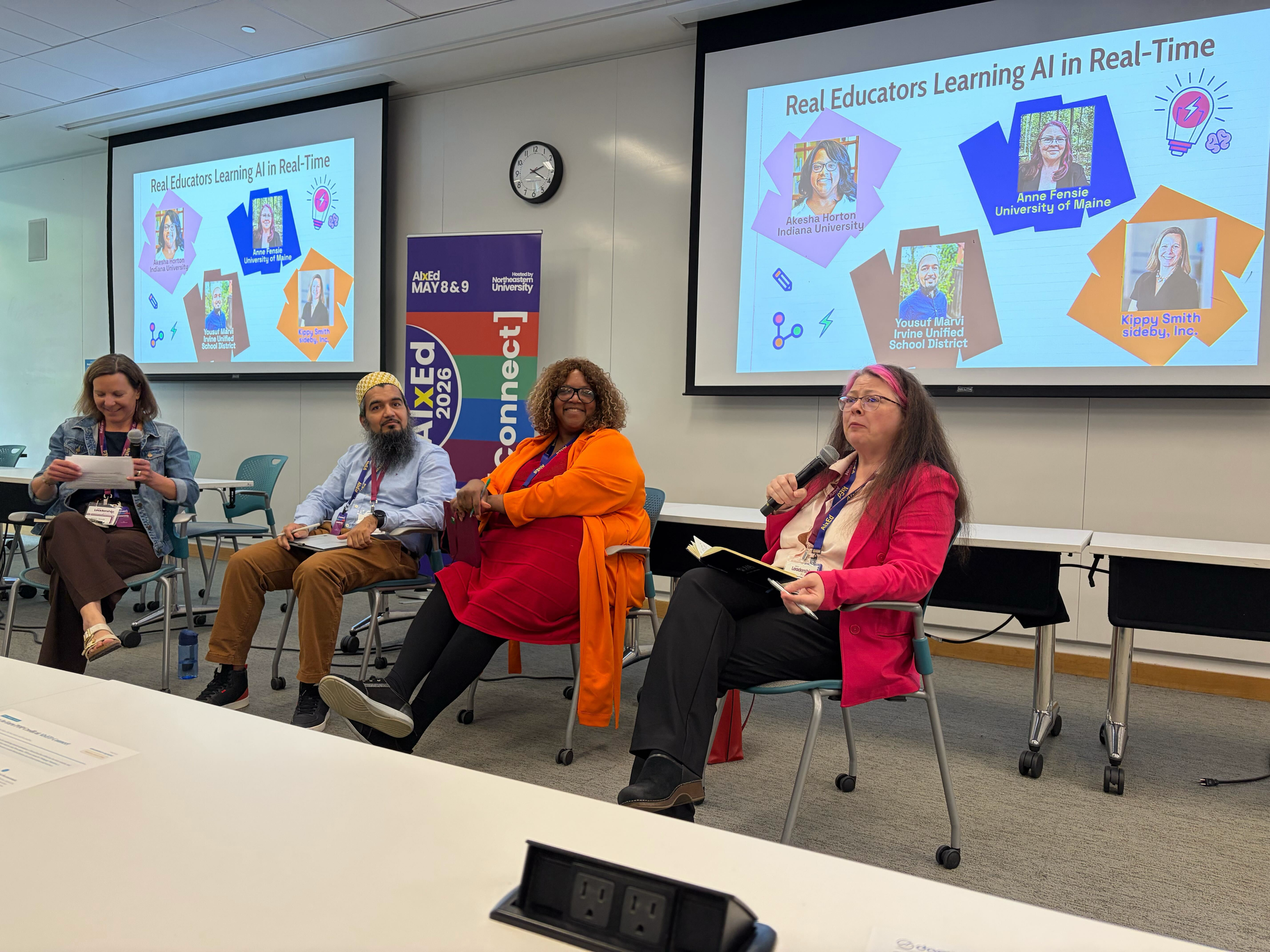
AI fluency is a transformational set of skills that educators are learning on the job, often without a roadmap or coherent guidance from their organizations. The conversation surfaced important insights about how educators in K12 and higher education institutions are navigating this complex terrain:
Efficiency is not the “why” — deeper learning is.
Kippy asked each panelist their "why" for using AI, and not one of them opened with saving time. It would be easy to assume that educators' primary motivation for adopting AI is getting time back. The grading, the planning, the emails — AI can help with all of it, and there's nothing wrong with that. While efficiency is primarily where individuals and organizations alike are focusing their AI attention, these educators’ purposes centered on teaching and learning. They expressed a genuine belief that AI can open doors for students who've been locked out by the text-heaviness of traditional learning environments, and a concern that AI might remove productive struggle from students’ learning experience. They also noted the great opportunity AI poses to educators: it empowers them to be creators rather than just consumers of EdTech tools, thus enabling them to better design learning in service of equitable student achievement, resilience, problem-solving, and agency — all Deeper Learning outcomes (Learning Policy Institute, 2026).
Building AI fluency through experiential learning… and plenty of mistakes
The educators on this panel aren't building fluency by taking courses or waiting until they feel ready. They're building it by finding real problems, trying things, and paying close attention to what happens. That means taking risks and gaining valuable insight from mistakes. As David Kelley says in Creative Confidence, “Failure sucks but instructs” (Kelley & Kelley, 2013, p.115). (We drew inspiration from Kelley when designing the Small Wins Dashboard, which defines lessons learned from what didn’t work as wins.) The fluency these educators have developed isn't theoretical. It lives in the specific moments where AI failed them, and they had to figure out why.
Another key element of their experiential learning approach: they aren’t going it alone. Each panelist discussed the importance of learning with and from other educators. Yousuf noted that sideby’s peer-to-peer learning model helps him reflect on his experiences and get fresh ideas from others in the field.
How hesitant educators are getting started
An audience member asked the practical question directly: how do you actually begin, especially if you’re feeling a little resistant? The sense that everyone else is further along than you is, almost certainly, not accurate — and it's one of the more paralyzing stories educators tell themselves about AI right now. The more useful question isn't "how do I catch up?" but "what's a real problem in front of me right now?" Not a hypothetical classroom application. A real, low-stakes problem where it doesn't matter much if the tool fails. Start there, notice what the tool is good for and where it gets in the way, and let that be the start of your learning journey. Anne's answer was small daily reps — pick something low-stakes and just try it. Akesha’s example: she used AI to develop a tool that reads her refrigerator and suggests dinners that work around her family’s divergent preferences.
The panel also delved into what’s making educators hesitant to experiment with AI in the first place. These Six Tensions are summarized in Akesha Horton’s blog, which embeds an interactive reflection tool one can use to raise awareness of their AI learning approach and what’s holding them back.
What educators need more of to become AI fluent
When asked to pinpoint the types of learning experiences educators need more of in order to become AI fluent, the panelists identified:
Structured peer collaboration
Project-based, peer-networked learning
Positioning AI as an invitation for genuine curiosity and skepticism
Underneath all three answers was the same conviction: the professional learning model that works for scaling up known best practices — expert-led, module-based, top-down — is the wrong model for a moment when no one yet agrees on what best practice looks like. What these educators are asking for instead is structural support for the kind of learning that's actually working: opt-in, peer-driven spaces where educators can experiment together. Underneath that is a larger shift in orientation — from AI adoption as something institutions roll out, to AI adoption as something educators explore, with genuine curiosity and genuine skepticism both treated as legitimate. That reframe doesn't slow the work down; it makes the work more likely to stick.
Resources
Learning Policy Institute. (2026). Deeper learning. https://learningpolicyinstitute.org/topic/deeper-learning
Kelley, D., & Kelley, T. (2013). Creative confidence: Unleashing the creative potential within us all. Crown Business.
Kelley, T., & Kelley, D. (2026). Creative confidence. https://www.creativeconfidence.com/
Horton, A. (2026, May 12). The seventh tension. 4 Degrees & Feelings: AI + Tea. https://akesha.substack.com/p/the-seventh-tension