
The Most Important Skills for the AI Era Aren't Technical
By Kippy Smith and Erica Crane, EdD
Ask most educators what they're hearing about AI professional development and the answer tends to be some version of the same thing: which tools to use, which prompts to try, which platforms are worth learning. The conversation is largely technical, and understandably so. The tools are new, they're changing rapidly, and they can have an immediate impact on your work.
But there's a conversation we have far less often, and it may be the more important one: what it takes for educators to harness AI's transformational potential.
In our first two posts in this series, we discussed how the messy AI experimentation phase we're in calls for a fundamentally different kind of professional learning — one built on shared vision, peer exchange, and the courage to fail forward. And we argued that the north star for all of it isn't efficiency but deeper, more equitable learning for every student. This third post asks: what does the educator in the middle of this innovation process actually do?
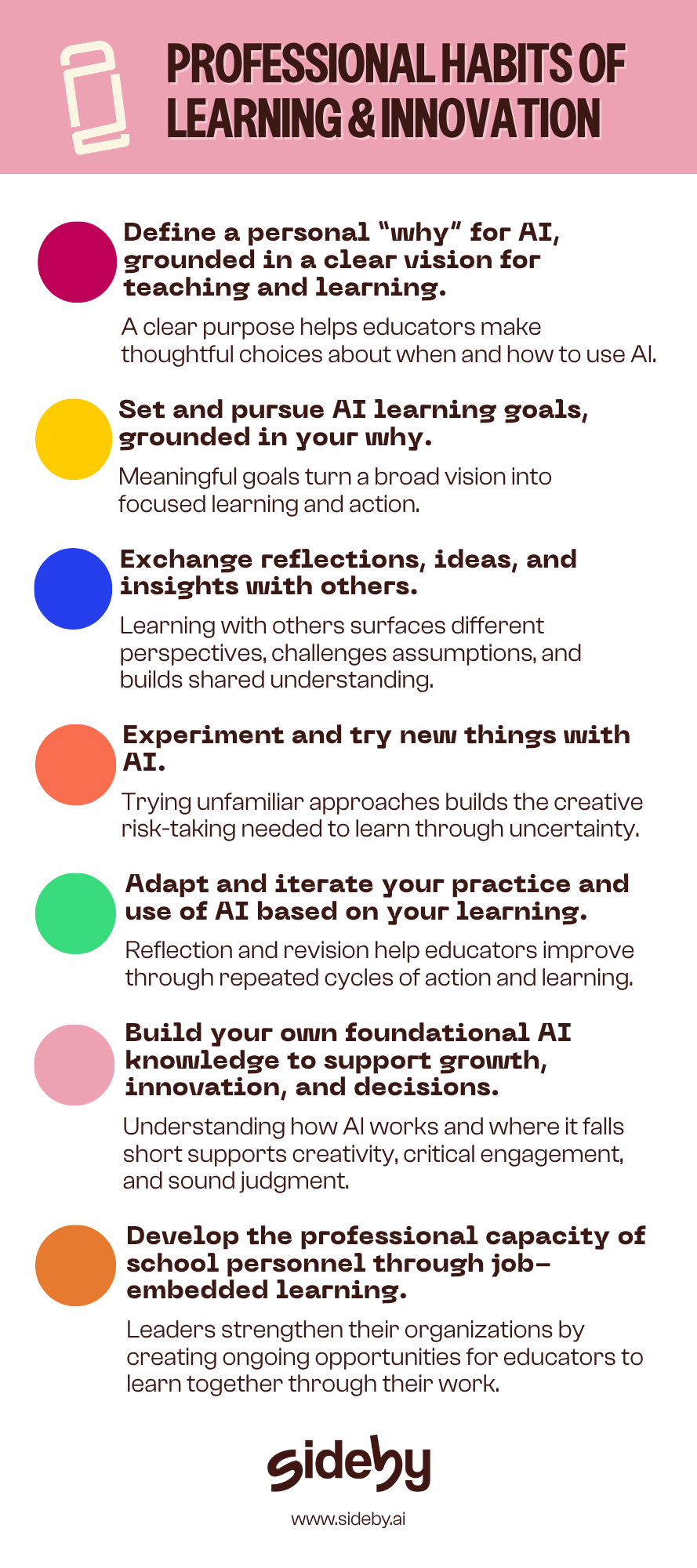
Our answer: educators who creatively leverage AI in bold pursuit of equitable deeper learning demonstrate Professional Habits of Learning and Innovation. These habits are a set of recurring behaviors that yield innovative solutions, resilience, and belief in one's ability to overcome challenges and reach their bold goals. While these habits are practiced by individuals, they are cultivated by the organizations and systems in which individual educators operate. Organizations and systems are responsible for creating the conditions in which professional habits of learning & innovation exist. These habits are the human advantage in the AI world: uniquely human attributes that AI can't replace and that are essential to truly transforming teaching & learning.
In other words, harnessing AI's transformational potential requires leaning into the things that make us inherently human.
The Human Advantage
AI is becoming extraordinary at a growing range of tasks: synthesizing information, generating content, identifying patterns in data, producing consistent outputs at scale. The human advantage is a set of capacities that are rooted in something AI fundamentally lacks: lived experience, self-reflection, curiosity, emotional intelligence, making meaning in context, and an urge to keep growing.
The Professional Habits of Learning and Innovation are essentially the human advantage in action. Although these behaviors and practices are inherently human, that doesn't mean people (and specifically educators) exhibit them routinely. Building (or rebuilding) these habits is attainable, however- especially when educators operate in a professional environment designed to foster creativity, team learning, collaboration and collective efficacy.
At sideby, we explicitly define research-based Professional Habits of Learning & Innovation and bake them into every sideby learning experience for two reasons:
So educators can build, rebuild, or strengthen these habits, just like exercising a muscle.
So new ways of teaching & learning can occur. These habits exemplify, in granular detail, how transformation happens — the things educators concretely do, individually and collectively, to yield transformational learning outcomes.
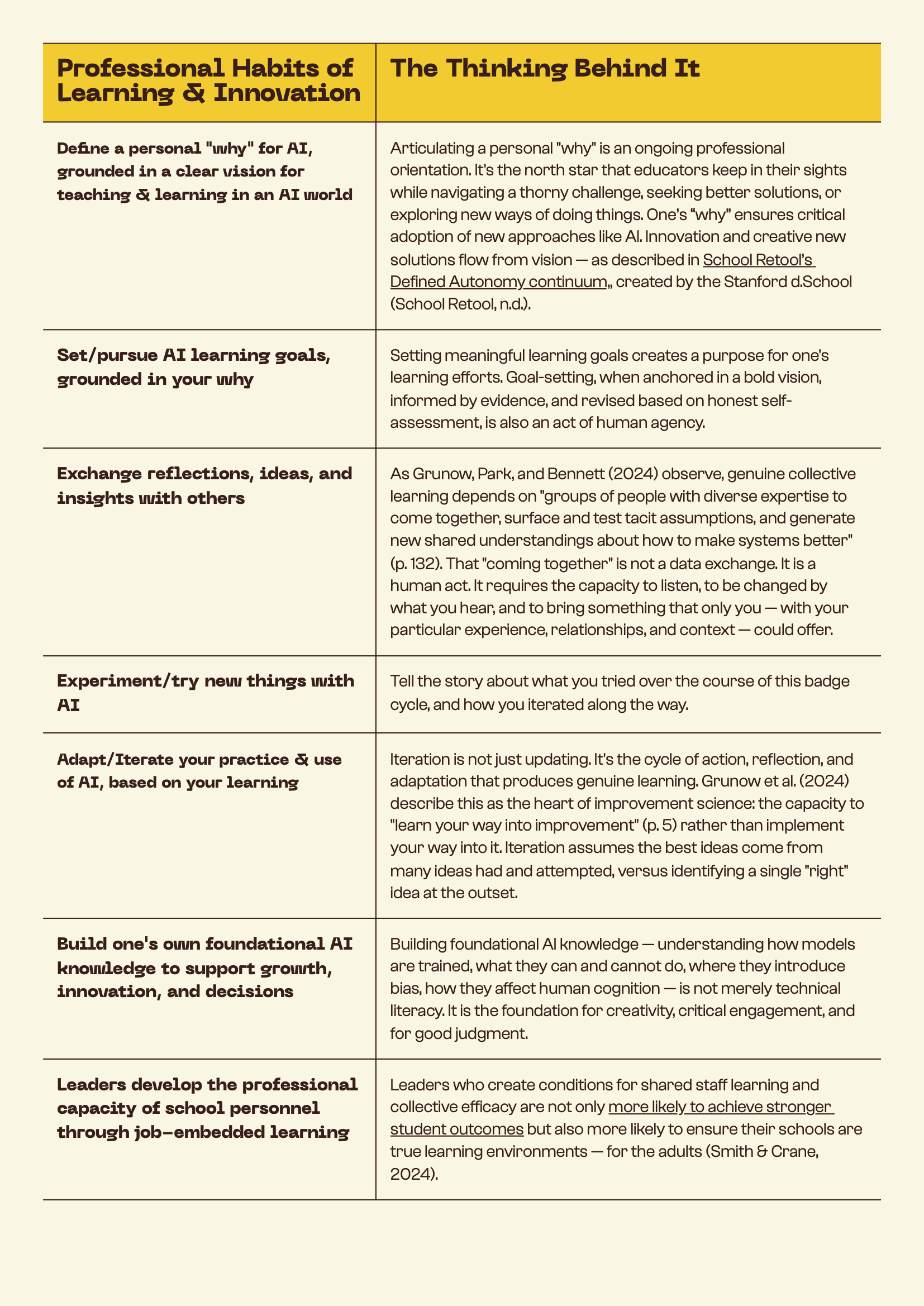
sideby's Professional Habits of Learning & Innovation in Detail
Students See What Educators Practice
There is one more dimension of these Professional Habits that deserves naming: educators who develop these habits aren't only growing themselves. They're modeling, in real time, the capacities their students need most.
An educator who brings authentic curiosity to an AI experiment is teaching curiosity. One who shares what a lesson that failed revealed — and what they changed — is teaching resilience. One who asks, “Why does this matter?” before adopting a new technology is teaching purpose-driven judgment. These are not incidental effects of Professional Habits. They may be their deepest impact.
We believe that the most important thing educators can do with AI right now isn't to master it. It's to stay genuinely curious about it, to bring the full breadth of their human intelligence to the encounter, and to practice the habits that will allow them to keep learning and leading as AI keeps changing.
References
Grunow, A., Park, S., & Bennett, B. (2024). Journey to improvement: A team guide to systems change in education, health care, and social welfare. Rowman & Littlefield.
School Retool. (n.d.). Creating change in schools. [Creative Commons Attribution 4.0 International License.]
Smith, K., & Crane, E. (2024, March 11). Collective efficacy is the most powerful renewable resource. Small Wins Dashboard. https://www.smallwinsdashboard.com/blog/collective-efficacy-as-the-most-powerful-renewable-resource
Wolfe, R. E. (2026, January). Can't get there from here: A framework for the start, spread, and scale of bottom-up innovation in education. Hoover Institution, Stanford University.
TL;DR
The AI experimentation phase demands something deeper than technical skill: the professional habits that allow educators to learn, adapt, and lead alongside uncertainty.
sideby's Professional Habits of Learning and Innovation — purpose, goal-setting, exchange, experimentation, iteration, knowledge-building, and team leadership — help educators strengthen these habits while also transforming teaching & learning.
Educators who develop these habits are modeling the human advantage skills their students will need most in an AI-saturated world.