
Beyond Efficiency: Using AI to Unlock Deeper Learning
By Kippy Smith and Erica Crane, EdD
Efficiency Matters
The efficiency gains AI can offer teachers are genuinely significant and needed. Generating differentiated materials in minutes instead of hours, synthesizing assessment data, communicating with families in multiple languages are not trivial. Teacher burnout and retention are urgent crises (Steiner et al., 2025, as cited in Wolfe, 2026), and anything that meaningfully reduces workload creates better conditions for teaching and learning.
But efficiency is where the story starts, not where it ends. Efficiency is an enabling condition for real transformation of student learning to occur. Saving time makes space for creativity, resilience, optimism, and growth. As educator and author Steven Levy said to Kippy Smith, sideby’s Chief Learning Officer, "It's the space between the logs that enables a fire to burn."
“It’s the space between the logs that enables a fire to burn."
— Steven Levy
When "AI for education" centers on efficiency alone, we optimize existing processes rather than reimagine what's possible. We also lose the ability to evaluate quality. If the only measure of success is "did it save time?", then faster ineffective instruction counts as a win. And the equity stakes couldn't be higher. Students who have been least well-served by traditional schooling stand to gain tremendously from transformational approaches. These potential gains evaporate if we simply use AI to run the existing system faster.
Anchor to the Bigger Vision
When educators ask themselves what AI can help them do differently versus faster, the possibilities for student learning expand dramatically.
What does it look like when every student in a class of 32 gets personalized, substantive feedback? When a multilingual learner gets real-time support in their home language and can engage with grade-level content more easily? When a student uses AI as a thinking partner to develop an argument, not to skip developing one?
These stories paint a picture of what transformed student learning could look like. Transformation is possible through collective approaches to continuous improvement.
Research on school change is consistent: the most durable improvements happen when educators are aligned around a shared, compelling purpose or vision rather than a shared tool (School Retool, n.d.). That's exactly how we should approach AI adoption: collectively learning how AI might help us move closer to our vision for student learning.
When educators explore AI through that lens, the conversations get better. They're asking: What does this make possible for my students? What does it make harder?
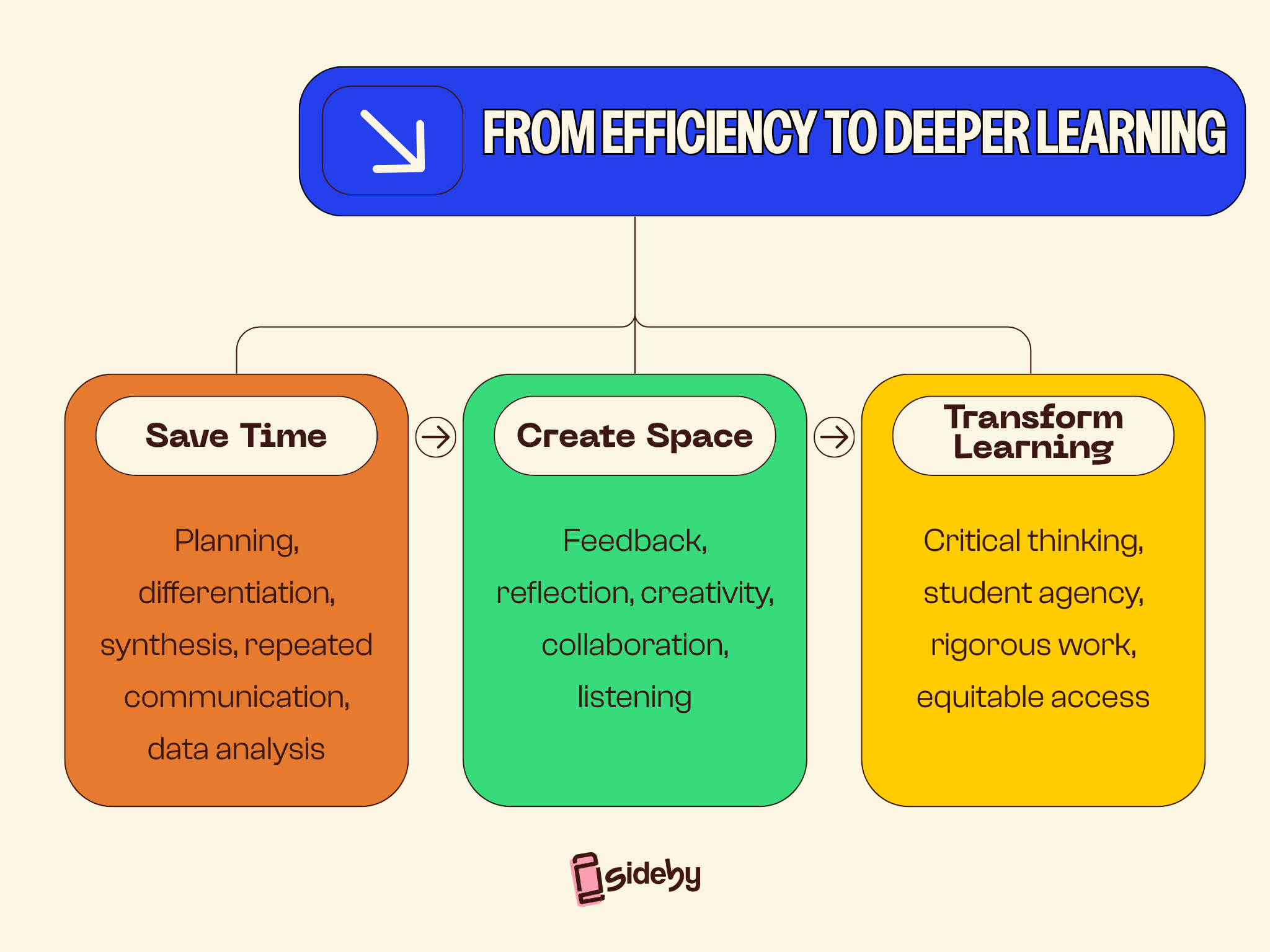
sideby's Why of AI: Deeper Learning
At sideby, we believe AI's highest purpose in education is to help educators, schools, and systems create transformational learning experiences leading to equitable deeper learning outcomes for the full range of learners.
The William and Flora Hewlett Foundation's deeper learning framework describes what students actually need: mastery of core academic content, yes — but also critical thinking and problem-solving, effective communication, the ability to work collaboratively, academic mindsets, and the capacity to keep learning throughout their lives (William & Flora Hewlett Foundation, 2013). AI doesn't support those outcomes by making current instruction faster. It supports them by making different instruction possible. It can give teachers the capacity to offer every student the kind of patient, iterative, responsive feedback that builds rigorous, complex thinking, at a scale individual teachers can struggle to deliver.
And the outcomes are real: a large-scale AIR study found that students in schools explicitly focused on deeper learning graduated on time at rates roughly 8 percentage points higher than peers in comparison schools (American Institutes for Research, 2016). Critically, these gains held for students living in poverty and for other traditionally underserved groups.
The educators in sideby’s open learning community and partnerships focused on AI are collectively experimenting with AI in pursuit of widespread deeper learning outcomes for their full range of learners. In peer-driven conversations, they exchange ideas, reflect, critically question, and make sense of their experiences. AI-enabled efficiencies are indeed part of their conversations, but as a threshold for exploring how to do things differently in service of deeper student learning.
References
American Institutes for Research. (2016, August). Does deeper learning improve student outcomes? Results from the Study of Deeper Learning: Opportunities and Outcomes. https://www.air.org/project/study-deeper-learning-opportunities-and-outcomes
EL Education. (n.d.). Three dimensions of student achievement. https://www.eleducation.org/who-we-are/three-dimensions-of-student-achievement/
School Retool. (n.d.). Creating change in schools. [Creative Commons Attribution 4.0 International License.]
William and Flora Hewlett Foundation. (2013, April). Deeper learning defined. https://hewlett.org/wp-content/uploads/2016/08/Deeper_Learning_Defined__April_2013.pdf
Wolfe, R. E. (2026, January). Can't get there from here: A framework for the start, spread, and scale of bottom-up innovation in education. Hoover Institution, Stanford University.
TL;DR
AI's efficiency gains for teachers are real and worth pursuing, but efficiency is the starting point, not the destination. The real north star is equitable, deeper learning for every student.